


- IAGES
- ASI — Association of Surgeons of India
- SAGES
- International surgical societies
Quick answer
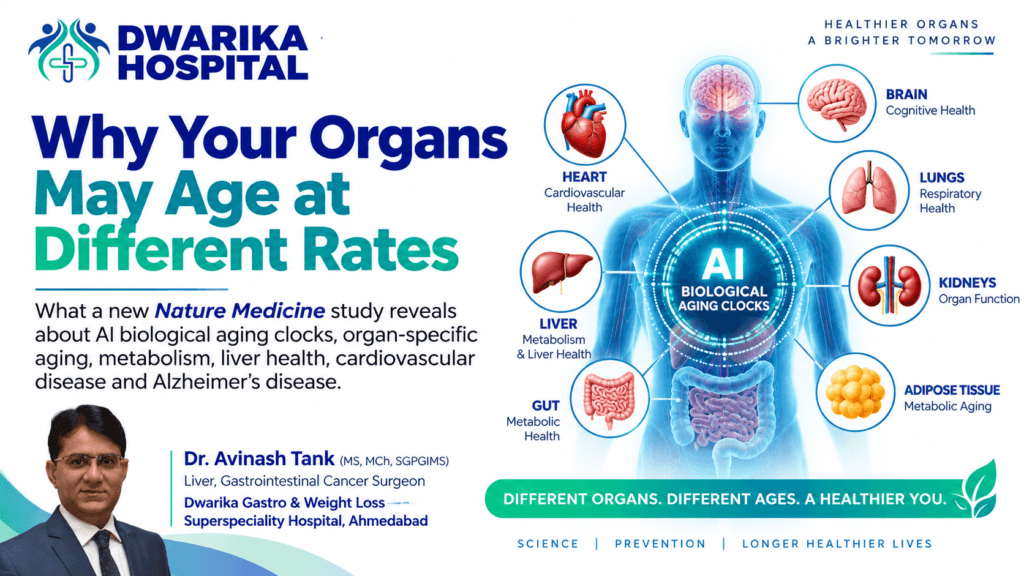
AI & snippet readyWhy Your Organs May Age at Different Rates What a new Nature Medicine study reveals about AI biological aging clocks, organ-specific aging, metabolism, liver health, cardiovascular disease and Alzheimer’s disease Dr. Avinash Tank, MS, MCh, SGPGIMS Liver, Gastrointestinal & Obesity Surgeon Dwarika Gastro & Weight Loss Superspeciality Hospital, Ahmedabad Introduction How old is your body […]
Key takeaways
Why Your Organs May Age at Different Rates
Introduction
What Is Biological Age?
Example
Why Does Sex Matter in Biological Aging?
What Did the New Nature Medicine Study Do?
Why Your Organs May Age at Different Rates
What a new Nature Medicine study reveals about AI biological aging clocks, organ-specific aging, metabolism, liver health, cardiovascular disease and Alzheimer’s disease
Dr. Avinash Tank, MS, MCh, SGPGIMS Liver, Gastrointestinal & Obesity Surgeon Dwarika Gastro & Weight Loss Superspeciality Hospital, Ahmedabad
Introduction
How old is your body biologically?
Your chronological age is simple: it is the number of years since you were born.
But biological aging is much more complicated.
Two people of the same chronological age may have very different levels of biological deterioration. One person may have relatively healthy cardiovascular, metabolic and brain function, while another may already have evidence of accelerated aging in several organs.
A new study published in Nature Medicine in September 2026 takes this concept a step further. Researchers developed 38 sex-specific biological aging clocks covering 15 organ systems and three major types of biological data. The study found that biological aging can differ between females and males and that aging of individual organs may provide information that a single whole-body aging score cannot capture.
This raises an important question:
Is there really one “biological age,” or do different organs have their own biological ages?
The evidence increasingly points toward the second possibility.
What Is Biological Age?
Chronological age measures the passage of time.
Biological age attempts to estimate how old the body's tissues and biological systems appear to be based on measurable characteristics.
Artificial intelligence and machine-learning models can analyse large amounts of biological information and estimate a person's expected age.
For example, an AI model may analyse:
- MRI scans
- Blood proteins
- Metabolites
- Genetic information
- Clinical measurements
- Organ-specific imaging
- Other molecular biomarkers
The difference between the AI-predicted biological age and chronological age is often called the biological age gap (BAG).
Example
A 55-year-old person may have:
- Chronological age: 55 years
- AI-predicted biological age: 62 years
The biological age gap would be approximately +7 years.
Conversely, a 55-year-old whose biological age is estimated at 49 years would have a biological age gap of approximately −6 years.
However, biological age should not be interpreted as a precise measurement of how many years a person has left to live. It is better understood as a biomarker of biological characteristics associated with aging.
Why Does Sex Matter in Biological Aging?
Many biological aging models have traditionally combined females and males into the same training population.
That approach assumes that the biological relationship between aging and the measured variables is sufficiently similar across sexes.
But human biology does not always work that way.
Sex-related biological differences can influence:
- cardiovascular disease
- metabolic disease
- immune function
- endocrine pathways
- brain aging
- neurodegenerative disease
- body composition
- liver metabolism
- vascular biology
The Nature Medicine study therefore asked whether biological aging clocks should be developed separately for females and males.
The investigators found evidence that sex-stratified models can identify patterns that may be obscured when both sexes are pooled together.
What Did the New Nature Medicine Study Do?
The researchers developed 38 sex-specific biological aging clocks across 15 organ systems.
They used three broad categories of biological information:
1. MRI-based biological aging
Magnetic resonance imaging was used to develop organ-specific aging measures.
These included biological aging measures associated with organs such as:
- brain
- heart
- liver
- spleen
- adipose tissue
- other organ systems
2. Proteomic biological aging
Proteomics measures proteins circulating in the blood.
The researchers developed multiple protein-based biological aging clocks, allowing them to investigate molecular pathways associated with aging.
3. Metabolomic biological aging
Metabolomics examines small molecules involved in metabolism.
These measurements provide information about systemic metabolic processes and can reveal biological signatures associated with aging.
Together, these approaches create a much more detailed picture than simply asking:
“How old does this person look biologically?”
The more useful question may be:
“Which biological systems are aging faster than others?”
The Most Important Finding: Aging Is Not Uniform Across the Body
One of the major implications of this research is that biological aging is organ-specific.
Your brain may have one biological aging trajectory.
Your liver may have another.
Your cardiovascular system may have another.
Your metabolic system may have another.
This means that a person could potentially have:
Relatively preserved brain aging + accelerated metabolic aging + accelerated vascular aging.
Another person of exactly the same chronological age could have an entirely different pattern.
This concept is important because many chronic diseases are not simply “age-related.”
They are related to how individual biological systems age.
Why Sex-Specific AI Aging Clocks May Be Better
The investigators compared sex-specific models with models trained using pooled female and male populations.
In their analyses, sex-stratified models showed improved performance in some settings, including better generalization in the evaluation of adipose-tissue aging.
Why could this happen?
Imagine that a biological measurement changes with age differently in females and males.
If both groups are mixed into one model, the AI has to learn a compromise relationship.
That compromise may be less representative of either group.
Separate models allow the algorithm to establish:
Female normative aging reference
and
Male normative aging reference
The biological age gap can then be calculated against the appropriate reference population.
This is particularly important when biological differences between sexes are substantial.
Genetics Also Appeared to Differ Between Females and Males
The study investigated the genetic architecture associated with biological aging.
The researchers found evidence that genetic contributions to biological aging can differ between females and males depending on the organ system and biological measure.
For example, the study reported sex-dependent patterns involving:
- liver-related biological aging
- metabolic aging
- brain aging
- other organ-specific aging measures
This does not mean that one sex “ages better” than the other.
Instead, it suggests that the biological pathways influencing aging can be configured differently in females and males.
The Liver Is Particularly Interesting
The findings involving liver and metabolic aging are particularly relevant to modern preventive medicine.
The study identified sex-dependent genetic and molecular associations involving hepatic and metabolic biological aging.
This supports an increasingly important concept:
Liver aging is not simply a consequence of chronological age.
The liver is continuously exposed to metabolic stress from:
- obesity
- insulin resistance
- type 2 diabetes
- excess visceral fat
- alcohol
- medications
- inflammation
- metabolic dysfunction-associated steatotic liver disease (MASLD)
Therefore, two people who are both 50 years old may have very different liver biological states.
One may have relatively preserved hepatic function.
Another may have significant metabolic and structural changes despite having the same chronological age.
AI-based organ-specific aging biomarkers could eventually help researchers understand this heterogeneity more precisely.
However, these biological aging clocks should not currently be treated as established clinical diagnostic tests for liver disease.
Biological Aging and Cardiometabolic Disease
The study also investigated whether biological age gaps were associated with future disease.
In females, several biological aging measures were associated with future cardiometabolic outcomes.
For example, the researchers reported associations involving:
- heart biological aging and future hypertension
- immune/metabolic aging and hypercholesterolemia
- metabolic aging and type 2 diabetes
Some reported hazard ratios were approximately 1.25–1.5 for selected associations.
This is important because it suggests that biological aging measurements may capture aspects of disease vulnerability beyond chronological age.
But an association does not automatically establish causation.
A biological aging clock is therefore better viewed as a risk-associated biomarker rather than a standalone diagnosis or treatment decision tool.
Biological Aging and Mortality
The researchers also examined all-cause mortality.
They found significant associations between several biological aging measures and mortality in both females and males, with the pattern varying according to sex, organ and biological data type.
The important message is not that a particular biological age number determines lifespan.
Instead:
Accelerated biological aging in particular organ systems may identify individuals with greater accumulated biological vulnerability.
This could eventually have implications for:
- preventive medicine
- risk stratification
- clinical research
- healthy aging interventions
- selection of participants for clinical trials
Brain Aging and Alzheimer's Disease
One of the most interesting components of the study involved the brain.
The investigators examined sex-specific brain biological aging using MRI-derived aging measures.
They analysed longitudinal data from the Alzheimer's Disease Neuroimaging Initiative (ADNI) and also examined data from the A4 preclinical Alzheimer's disease trial.
The researchers found sex-dependent relationships between brain biological aging and cognitive decline trajectories.
This is particularly relevant because Alzheimer's disease already demonstrates important differences between females and males in:
- disease burden
- cognitive trajectories
- risk factors
- biological mechanisms
The findings suggest that sex-specific brain aging measures could potentially reveal patterns that are less visible in pooled models.
What Does “Biological Age Gap” Actually Mean?
It is important not to misunderstand this concept.
A biological age gap does not mean:
“You will die seven years earlier.”
Nor does it mean:
“Your liver is literally seven years older.”
Rather, it represents a statistical difference between:
AI-estimated biological characteristics associated with age
and
chronological age.
The interpretation depends heavily on:
- the dataset used to build the model
- the organ being studied
- the biological data used
- the population in which the model was developed
- the model's calibration
- external validation
Therefore, biological age should not be treated as a simple clinical thermometer for aging.
Why One Biological Age Score May Not Be Enough
Imagine a hypothetical 60-year-old patient.
A conventional whole-body biological aging score might classify the person as:
Biological age: 61
That sounds reassuring.
But suppose organ-specific measurements reveal:
The single number “61” hides important information.
An organ-specific model could instead identify:
Metabolic and hepatic systems as the dominant areas of accelerated biological aging.
That information could potentially be much more useful for preventive medicine.
What Could This Mean for Obesity Medicine?
This research is especially interesting in the context of obesity.
Obesity is not simply an increase in body weight.
It can affect multiple biological systems simultaneously.
Excess adiposity can be associated with:
- insulin resistance
- fatty liver disease
- hypertension
- dyslipidemia
- cardiovascular disease
- chronic inflammation
- sleep disorders
- altered metabolic signalling
Therefore, two patients with the same BMI may have very different biological health profiles.
For example:
Patient A
BMI 32 kg/m² Normal blood pressure Normal glucose Minimal liver fat Good physical activity
Patient B
BMI 32 kg/m² Type 2 diabetes Hypertension MASLD Dyslipidemia Reduced physical activity
Their chronological age and BMI may be similar.
Their biological aging profile may be very different.
This is one reason modern obesity medicine increasingly needs to move beyond BMI alone.
Could Biological Aging Help Personalize Weight-Loss Treatment?
Potentially—but this remains an area for research.
In the future, clinicians may be able to combine:
BMI + body composition + metabolic health + liver health + cardiovascular risk + biological aging biomarkers
to create a more comprehensive picture of an individual's health.
For example, biological aging biomarkers could potentially help researchers determine whether an intervention is associated with improvements in:
- metabolic aging
- cardiovascular aging
- liver aging
- inflammatory pathways
- overall biological age
However, the current Nature Medicine study does not establish that biological aging clocks should be used to choose a specific obesity treatment for an individual patient.
Clinical decisions should continue to rely on validated clinical evidence and established risk assessment.
What Does This Mean for Preventive Medicine?
The broader concept is powerful:
We may be moving from “How old are you?” toward “How are your organs aging?”
Chronological age remains essential.
But biological age may eventually provide additional information about health status.
And organ-specific biological age could potentially answer questions such as:
- Is cardiovascular aging accelerated?
- Is metabolic aging accelerated?
- Is liver aging accelerated?
- Is brain aging accelerated?
- Which biological systems show the greatest deviation from healthy aging?
- Does an intervention change these trajectories?
This could eventually support a more personalized approach to healthy aging.
Important Limitations
The findings are scientifically important, but they should not be overinterpreted.
1. Biological aging clocks are models
They are statistical predictions derived from datasets.
They are not direct measurements of “true biological age.”
2. Association does not equal causation
A higher biological age gap associated with disease does not necessarily mean that the aging clock itself causes disease.
3. Sex-specific models are not universally superior
The authors explicitly note that sex-pooled and sex-interaction models remain valuable, because substantial biological similarities exist between females and males.
4. Clinical utility still needs validation
A biomarker can predict outcomes statistically without necessarily improving patient outcomes when used in clinical practice.
5. Population differences matter
A model developed using large research cohorts may not perform identically in every population.
This is particularly relevant when considering application to populations such as Indian patients.
6. It is not yet a routine clinical test
At present, these research-grade biological aging clocks should not be confused with a standard clinical laboratory test that can independently diagnose disease or prescribe treatment.
The Bigger Picture: From Chronological Age to Biological Health
The most important contribution of this Nature Medicine study may not be the exact number of aging clocks.
It is the conceptual shift.
Traditional approach
Age → disease risk
Emerging approach
Age + organ biology + molecular signatures + genetics + clinical phenotype → individualized biological aging profile
This approach recognizes that aging is:
- heterogeneous
- organ-specific
- molecular
- sex-dependent
- influenced by genetics
- influenced by environment and lifestyle
And importantly, different organs may age at different rates.
What Should Patients Do With This Information?
Patients should not try to interpret an online “biological age calculator” as a medical diagnosis.
Instead, the practical lesson is simpler:
Protect the systems that influence healthy aging.
That means paying attention to:
- body weight and waist circumference
- blood pressure
- blood glucose
- lipid profile
- liver health
- physical activity
- muscle mass
- sleep
- smoking
- alcohol consumption
- nutrition
- mental and cognitive health
In other words:
Healthy aging is not about making one number younger. It is about maintaining the health of multiple biological systems.
Frequently Asked Questions
What is a biological aging clock?
A biological aging clock is an algorithm that uses biological measurements—such as MRI, proteins, metabolites or clinical data—to estimate age-related biological characteristics.
What is a biological age gap?
The biological age gap is generally the difference between an AI-estimated biological age and chronological age.
What are sex-specific biological aging clocks?
They are aging models trained separately in females and males to establish sex-specific normative aging references and identify biological aging patterns that may differ between the sexes.
How many aging clocks were developed in this Nature Medicine study?
The researchers developed 38 sex-specific biological aging clocks covering 15 organ systems and multiple omics modalities.
Which organs were studied?
The study included multiple organ systems using MRI, proteomic and metabolomic data. The analyses included biological aging signals involving systems such as the brain, heart, liver, spleen, adipose tissue, pulmonary, endocrine, immune and reproductive systems.
Can biological age predict disease?
Biological age gaps were associated with future disease endpoints and mortality in the study. However, these are statistical associations and should not be interpreted as individual predictions of future disease.
Can a biological aging clock diagnose liver disease?
Not based on this study. Research-grade biological aging clocks should not currently replace established clinical evaluation for liver disease.
Can biological aging be reversed?
The concept of “reversing biological age” remains an active area of research. A reduction in a biological age biomarker should not automatically be interpreted as proven reversal of the underlying aging process.
Does biological aging differ between females and males?
The study provides evidence that biological aging patterns, genetic architecture, molecular associations and clinical associations can differ between females and males. It also emphasizes that substantial biological similarities exist between the sexes.
Conclusion
The new Nature Medicine study provides an important advance in the science of biological aging.
Its central message is that biological aging is not necessarily one uniform process occurring at the same rate throughout the body.
Different organs can show different aging signatures, and these signatures may differ between females and males.
AI-based biological aging clocks may therefore eventually evolve from a single “biological age” number into a multidimensional biological aging map.
For obesity, metabolic disease and liver health, this concept is particularly relevant.
The future of preventive medicine may not simply ask:
“How old are you?”
It may ask:
“Which parts of your body are aging faster than they should—and what can we do about it?”
That is a much more personalized way of thinking about healthy aging.
Key Takeaway
Chronological age tells us how long we have lived. Biological aging research is increasingly trying to tell us how different parts of the body are aging—and why that may differ between individuals and between sexes.
How we get you better — step by step
From the blog
 Uncategorized
Why Your Organs May Age at Different Rates
Uncategorized
Why Your Organs May Age at Different Rates
Why Your Organs May Age at Different Rates What a new Nature Medicine study reveals about…
Read article → Vaccine
India Approves Its First Dengue Vaccine: What This Means for You and Your Family
Vaccine
India Approves Its First Dengue Vaccine: What This Means for You and Your Family
India has taken a major step in the fight against dengue by approving its first dengue va…
Read article → Uncategorized Metabolic Surgery and Type 2 Diabetes Remission: The EvidenceRelated Digestive Health Articles Liver: Life is not possible without liver. Know the rea…
Read article →Related patient videos
 DWARIKA HOSPITALVerified Patient Story
Verified
DWARIKA HOSPITALVerified Patient Story
Verified  DWARIKA HOSPITALVerified Patient Story
Verified
DWARIKA HOSPITALVerified Patient Story
Verified  DWARIKA HOSPITALVerified Patient Story
Verified
DWARIKA HOSPITALVerified Patient Story
Verified 
Super-specialist GI, bariatric & cancer surgeon. SGPGIMS (India's premier GI centre) + advanced training in Japan & South Korea. Read full profile →
Last reviewed: July 2026
Comments
Be the first to share your thoughts on this article.