
Nation First in Times of Global Uncertainty: Understanding the Logic Behind PM Modi’s 7 Appeals.
In periods of geopolitical instability, nations are tested not only on military strength or diplomatic influence, but also on economic resilience and civic discipline. The ongoing tensions involving the United States, Iran, Israel, and the wider West Asian region have once again highlighted how deeply interconnected the global economy has become. For countries like India — heavily dependent on imported crude oil, fertilizers, electronics, and global trade routes — international conflict can quickly affect daily life at home.
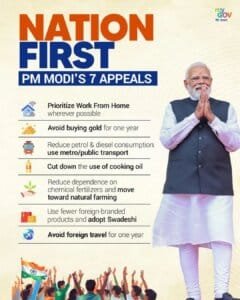
Against this backdrop, the seven public appeals associated with Narendra Modi can be viewed not merely as political messaging, but as strategic socio-economic guidance aimed at strengthening India’s resilience during uncertain times.
Rather than seeing these points emotionally or ideologically, it is important to analyze them rationally and pragmatically.
Why Global Geopolitics Matters to India
The conflict involving the US and Iran has already caused volatility in oil markets and concerns around the Strait of Hormuz — one of the world’s most critical oil transit routes. India imports a large percentage of its crude oil needs, making the country highly vulnerable to supply disruptions and price spikes. Analysts have warned that escalating tensions could sharply increase India’s fuel costs, inflation, import bills, and economic stress.
Higher oil prices impact nearly every Indian household:
- Petrol and diesel become expensive
- Transport and logistics costs rise
- Food inflation increases
- Airline fares increase
- Manufacturing becomes costlier
- The rupee weakens against the dollar
In such situations, even small collective behavioral changes by citizens can significantly reduce national economic pressure.
1. Prioritize Work From Home Wherever Possible
The COVID-19 era demonstrated that many industries can function efficiently through remote or hybrid work models.
Rational justification:
- Reduced fuel consumption
- Less traffic congestion
- Lower pollution levels
- Reduced dependence on imported crude oil
- Improved urban productivity
If even a small percentage of urban commuters avoid daily travel, the cumulative national fuel savings can be substantial.
During geopolitical crises, reducing unnecessary fuel demand becomes a strategic economic defense mechanism.
2. Avoid Buying Gold for One Year
India is among the world’s largest consumers of gold. However, India imports most of its gold using foreign currency reserves.
Why this matters:
- Gold imports increase pressure on India’s trade deficit
- Excessive gold buying weakens the rupee
- During crises, gold prices often surge globally
- Foreign exchange reserves become more valuable for essential imports like crude oil, medicines, and defense
In uncertain geopolitical environments, conserving foreign exchange becomes economically prudent.
This appeal is not anti-gold culturally — it is about temporary national financial prioritization.
3. Reduce Petrol & Diesel Consumption; Use Public Transport
This point is perhaps the most directly linked to the current geopolitical situation.
The Strait of Hormuz handles a major portion of global oil transportation. Any military escalation involving Iran can disrupt global oil supply chains and sharply increase prices.
Why reducing fuel use matters:
- India imports the majority of its crude oil
- High oil prices worsen inflation
- Government subsidy burdens increase
- Transportation costs affect all sectors
Using metro systems, buses, carpooling, or electric mobility reduces national vulnerability.
Countries that reduce unnecessary consumption during crises preserve economic stability better than those driven purely by consumerism.
4. Cut Down the Use of Cooking Oil
At first glance, this may appear unusual. But economically and medically, it has dual significance.
Economic rationale:
India imports large quantities of edible oils such as palm oil and sunflower oil. Global conflicts often disrupt supply chains and increase food commodity prices.
Reducing excessive oil consumption can:
- Reduce import dependence
- Lower household expenditure
- Improve national food security
Health rationale:
Excessive consumption of ultra-processed and oil-rich foods contributes to:
- Obesity
- Fatty liver disease
- Diabetes
- Heart disease
- Acid reflux and digestive disorders
Thus, this appeal aligns both with economic sustainability and preventive healthcare.
5. Reduce Dependence on Chemical Fertilizers; Move Toward Natural Farming
Global conflicts disrupt fertilizer supply chains because fertilizers depend heavily on:
- Natural gas
- Petroleum products
- International trade logistics
India imports a significant amount of fertilizers and fertilizer raw materials.
Why natural farming becomes relevant:
- Lower dependence on imported chemicals
- Improved soil sustainability
- Reduced long-term agricultural costs
- Better environmental balance
While complete replacement of fertilizers is unrealistic in the short term, reducing excessive chemical dependence is strategically sensible.
This is not merely an environmental slogan — it is an agricultural resilience strategy.
6. Use Fewer Foreign-Branded Products and Adopt Swadeshi
Global instability often exposes the risks of overdependence on foreign supply chains.
The COVID pandemic already showed how vulnerable nations become when essential goods rely heavily on imports.
Rational economic arguments for Swadeshi:
- Strengthens Indian manufacturing
- Generates local employment
- Retains wealth within the Indian economy
- Reduces import burden
- Encourages self-reliance in strategic sectors
This does not mean rejecting globalization entirely. Rather, it promotes balanced economic nationalism where critical sectors remain domestically resilient.
Many developed countries, including the US and China, actively protect strategic industries in similar ways.
7. Avoid Foreign Travel for One Year
International crises often lead to:
- Higher aviation fuel costs
- Currency depreciation
- Security uncertainties
- Rising travel expenses
Reducing non-essential foreign travel helps:
- Save foreign exchange
- Reduce luxury outflow spending
- Strengthen domestic tourism and local economies
At a national scale, even moderate reductions in outbound tourism can help conserve billions in foreign currency during turbulent periods.
The Bigger Message: Economic Patriotism During Crisis
These appeals can be understood through the concept of “economic patriotism.”
In wartime or global instability, nations often ask citizens to:
- Conserve resources
- Support domestic industries
- Reduce luxury imports
- Adopt disciplined consumption habits
This has historical precedent worldwide:
- Britain during World War II
- Japan after oil shocks
- South Korea during financial crises
- European energy conservation during the Russia-Ukraine conflict
India, as a rapidly growing but still import-dependent economy, remains vulnerable to energy shocks and supply disruptions.
A Balanced Perspective
It is also important to acknowledge:
- Some appeals may not be practical for everyone
- Urban public transport infrastructure varies
- Certain industries depend on global integration
- Economic openness remains important for growth
Therefore, these suggestions should not be interpreted as rigid mandates but as broad national guidance aimed at resilience and collective responsibility.
The key principle is moderation, preparedness, and prioritization during uncertain times.
Conclusion
The current geopolitical tensions involving the US, Iran, Israel, and the wider Middle East are not distant events for India. They directly affect:
- Fuel prices
- Inflation
- Currency stability
- Agriculture
- Trade
- Household expenses
Viewed rationally, the seven appeals attributed to PM Modi represent a framework for reducing economic vulnerability during a volatile global period.
Whether one agrees politically or not, the underlying logic behind these points reflects a broader reality:
In an interconnected world, national strength depends not only on governments and armies — but also on the everyday choices of ordinary citizens.
Was this article helpful?
Super-specialist GI, bariatric & cancer surgeon. SGPGIMS (India's premier GI centre) + advanced training in Japan & South Korea. Read full profile →
Last reviewed: July 2026






Comments
Be the first to share your thoughts on this article.