

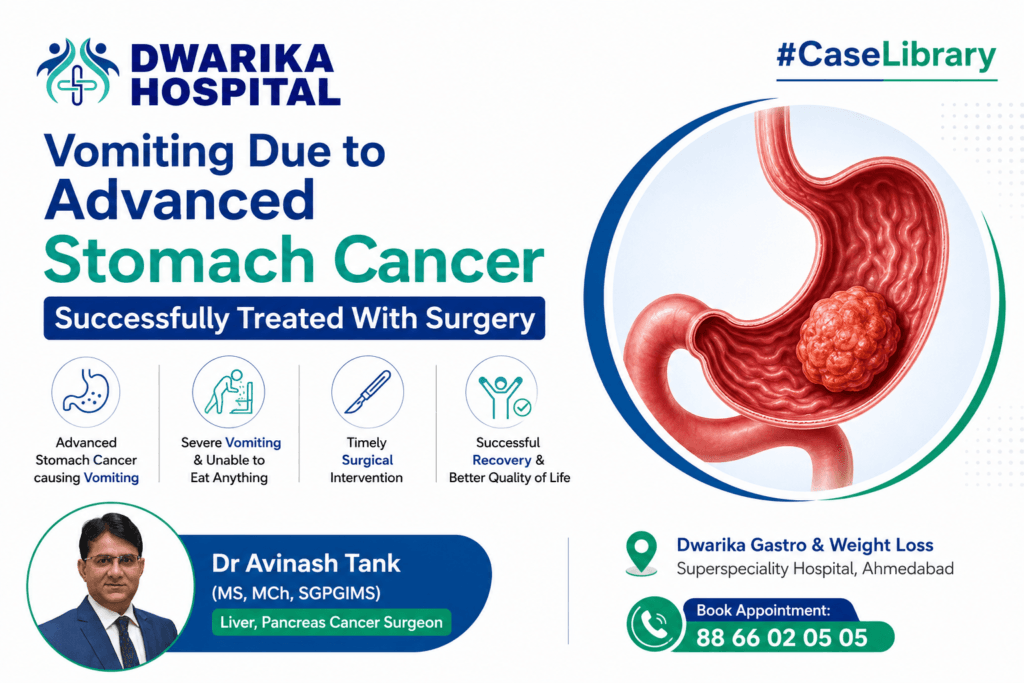
Clinical Summary
A 72-year-old gentleman with no major medical illnesses presented with progressively worsening loss of appetite and significant weight loss over four months.
During the last two weeks before admission, he became unable to tolerate even small amounts of food. Every meal resulted in fullness and vomiting.
Despite severe symptoms, his physical examination and blood investigations were surprisingly normal.
Further evaluation revealed an advanced cancer involving the distal stomach causing gastric outlet obstruction.
The patient underwent multidisciplinary evaluation followed by staging laparoscopy and radical subtotal gastrectomy with D2 lymphadenectomy.
An unexpected congenital intestinal non-rotation was encountered during surgery, requiring modification of operative strategy.
The patient recovered smoothly and was discharged on postoperative day six.
Why This Case Is Educational
This case demonstrates several important learning points:
- Gastric cancer may present only with loss of appetite and weight loss.
- Blood tests can remain normal despite advanced disease.
- Gastric outlet obstruction requires urgent management.
- Surgery remains the best treatment for resectable obstructing distal gastric cancer.
- Staging laparoscopy is an important step before radical surgery.
- Unexpected congenital anomalies can be encountered during surgery.
- Pathological staging may be much more advanced than clinical staging.
Patient Profile
| Parameter | Details |
|---|---|
| Age | 72 years |
| Gender | Male |
| Co-morbidities | None |
| ECOG Performance Status | 1 |
Presenting Complaints
The patient reported:
- Reduced appetite for 4 months
- Progressive weight loss
- Early satiety
- Recurrent vomiting
- Unable to tolerate food for 2 weeks
These symptoms strongly suggested progressive gastric outlet obstruction.
Initial Clinical Examination
Physical examination showed:
- No palpable neck lymph nodes (no supraclavicular lymphadenopathy)
- Abdomen soft
- No abdominal mass
- No ascites
- No jaundice
- No hepatomegaly
Routine laboratory tests including liver and kidney function were within normal limits.
Clinical Red Flags
Although investigations were normal, the following symptoms immediately raised concern for gastric cancer:
- Age >70 years
- Significant weight loss
- Progressive anorexia
- Persistent vomiting
- Food intolerance
- Gastric outlet obstruction
These “alarm symptoms” required urgent upper gastrointestinal endoscopy.
Diagnostic Evaluation
Step 1 – Upper GI Endoscopy
Upper GI endoscopy demonstrated:
- Large irregular ulceroproliferative growth
- Distal body and antrum involvement
- Gastric outlet obstruction
- Endoscope could not pass beyond the lesion
Multiple biopsies were obtained.

Histopathology
Biopsy confirmed:
Poorly differentiated adenocarcinoma with signet ring cell features
Why is this important?
Signet ring cell carcinoma is an aggressive subtype of gastric cancer.
It often:
- infiltrates diffusely,
- spreads early,
- causes extensive lymph node metastasis,
- has a higher risk of peritoneal spread,
- requires aggressive oncological treatment.
CT Scan
CT scan demonstrated:
- Distal gastric wall thickening
- Dilated stomach due to outlet obstruction
- No obvious liver metastasis
- No distant organ metastasis
CEA level:
8 ng/mL

Final Preoperative Diagnosis
Distal stomach adenocarcinoma involving the distal body and antrum
Associated with
- Gastric outlet obstruction
- Poorly differentiated histology
- Signet ring cell component
Multidisciplinary Tumor Board Discussion
The patient’s case was reviewed by the multidisciplinary tumor board including:
- Surgical Gastroenterologist
- Medical Oncologist
- Gastroenterologist
- Radiologist
- Pathologist
- Anaesthesiologist
Clinical Decision Making
Why was surgery performed first?
Normally, many patients with locally advanced gastric cancer receive neoadjuvant chemotherapy before surgery.
However, this patient had complete gastric outlet obstruction.
He could not tolerate oral nutrition.
Delaying surgery for chemotherapy would have resulted in:
- worsening malnutrition,
- dehydration,
- repeated vomiting,
- poor chemotherapy tolerance,
- reduced quality of life.
Therefore, the MDT decided that surgery should be performed first.
Why Was Staging Laparoscopy Done?
Before performing radical gastrectomy, staging laparoscopy was performed to exclude occult metastatic disease.
This is particularly important because:
- signet ring cancers frequently spread to the peritoneum,
- CT scans may miss microscopic metastases,
- unnecessary major surgery can be avoided if metastatic disease is detected.
Fortunately,
there was no evidence of peritoneal metastasis, allowing curative surgery to proceed.
Intraoperative Findings
During surgery, an unexpected congenital anomaly was identified.
Complete Intestinal Non-Rotation
The patient had complete intestinal non-rotation.
Findings included:
- Small intestine entirely on the right side
- Colon predominantly on the left side
This rare congenital anomaly had remained asymptomatic throughout his life.
Recognising this anatomy was essential to avoid vascular injury and to safely perform radical gastrectomy and reconstruction.
Tumor Findings
Operative assessment showed:
- Large antral tumor
- Extension to the lesser curvature
- Serosal involvement
- No gross liver metastasis
- No peritoneal deposits

Surgical Procedure
The patient underwent:
- Exploratory staging laparoscopy
- Radical subtotal gastrectomy
- Standard D2 lymphadenectomy
- Roux-en-Y gastrojejunostomy reconstruction
- Feeding jejunostomy/NJ tube placement (as per institutional protocol)
The surgery achieved complete macroscopic tumor removal with negative proximal and distal margins.
Why Was Roux-en-Y Reconstruction Chosen?
Roux-en-Y gastrojejunostomy provides:
- Better gastric emptying
- Reduced bile reflux
- Lower gastritis risk
- Good long-term nutritional outcomes
- Reliable reconstruction after distal gastrectomy
Enhanced Recovery After Surgery (ERAS)
Recovery followed enhanced recovery principles.
Postoperative Day 1
- Oral clear liquids
- NJ tube feeding
- Early mobilisation
Postoperative Day 2
- Walking independently
Postoperative Day 4
- Soft diet initiated
Postoperative Day 6
- Drains removed
- Discharged home
Recovery was smooth without major complications.
Final Histopathology
Histopathology demonstrated:
| Finding | Result |
|---|---|
| Histology | Poorly differentiated adenocarcinoma |
| Tumor depth | pT4a |
| Lymphovascular invasion | Present |
| Perineural invasion | Absent |
| Margins | Negative |
| Lymph nodes examined | 32 |
| Positive lymph nodes | 32 |
Final pathological stage:
AJCC 8th Edition
pT4a N3b M0
Why Did Pathology Change the Stage?
Preoperative imaging estimates tumor stage but cannot accurately detect microscopic lymph node involvement.
The final pathology revealed:
- deeper invasion,
- extensive lymph node metastasis,
- lymphovascular invasion,
which indicated a higher pathological stage than initially suspected.
Adjuvant Treatment Plan
Because of:
- T4 disease,
- N3b nodal status,
- signet ring histology,
- lymphovascular invasion,
the patient was advised:
Adjuvant S-1 plus Oxaliplatin (SOX) chemotherapy for 6 cycles, followed by regular surveillance.
Prognosis
Although extensive nodal involvement increases the risk of recurrence, complete surgical resection combined with appropriate adjuvant chemotherapy offers the best opportunity for prolonged disease control and survival.
Long-term follow-up is essential to monitor for recurrence, nutritional deficiencies, and quality of life.
Key Clinical Learning Points
- Persistent loss of appetite in elderly patients should never be ignored.
- Weight loss plus vomiting strongly suggests gastric outlet obstruction.
- Normal blood tests do not exclude advanced gastric cancer.
- Upper GI endoscopy is the investigation of choice for alarm symptoms.
- Staging laparoscopy is valuable in locally advanced gastric cancer, especially with signet ring histology.
- Surgical plans may need modification when unexpected congenital anomalies such as intestinal non-rotation are encountered.
- Pathological staging is often more accurate than radiological staging.
- ERAS protocols can facilitate rapid recovery even after major gastric surgery.
Frequently Asked Questions (FAQ)
Can stomach cancer present without pain?
Yes. Many patients initially experience loss of appetite, weight loss, early satiety, or vomiting rather than pain.
What is gastric outlet obstruction?
It is blockage at the exit of the stomach, preventing food from passing into the small intestine, leading to vomiting, fullness, and dehydration.
Why is endoscopy necessary?
Endoscopy allows direct visualization of the stomach and enables biopsy, which is essential for confirming the diagnosis.
What does “signet ring cell carcinoma” mean?
It is an aggressive subtype of gastric adenocarcinoma characterized by diffuse infiltration and a higher likelihood of lymph node and peritoneal spread.
Why perform staging laparoscopy before surgery?
It can detect small peritoneal metastases not visible on CT scans, helping avoid unnecessary major surgery.
Why were 32 lymph nodes removed?
A D2 lymphadenectomy removes regional lymph nodes for accurate staging and improved oncologic clearance.
What does pT4a N3b M0 indicate?
The tumor has penetrated the serosal surface (T4a), metastasized to 16 or more regional lymph nodes (N3b), with no distant metastasis detected (M0).
Why is chemotherapy still needed after complete surgery?
Microscopic cancer cells may remain despite complete resection. Adjuvant chemotherapy reduces the risk of recurrence and improves survival.
Learning for Patients and Families
- Do not ignore persistent loss of appetite or unexplained weight loss, especially after the age of 50 years.
- Recurrent vomiting or inability to tolerate food requires urgent medical evaluation.
- Early diagnosis offers the best chance for cure.
- Surgery is only one part of treatment; chemotherapy, nutrition, physical activity, and regular follow-up are equally important.
- After gastrectomy, patients should expect dietary changes, including smaller frequent meals, vitamin supplementation, and long-term nutritional monitoring.
- Family support is vital for recovery, adherence to treatment, and emotional well-being.
Learning for Referring Doctors and Primary Care Physicians
- Recognize alarm symptoms—weight loss, anorexia, early satiety, persistent vomiting, iron-deficiency anemia, gastrointestinal bleeding, or dysphagia—and arrange prompt upper GI endoscopy.
- Do not rely on normal laboratory tests to exclude gastric cancer.
- Refer patients with suspected gastric outlet obstruction urgently to a center with gastroenterology and surgical oncology expertise.
- Nutritional optimization should begin as early as possible.
- Patients with resectable gastric cancer benefit from multidisciplinary evaluation before treatment decisions.
- Be aware that signet ring cell carcinoma has a higher risk of occult peritoneal disease; staging laparoscopy should be considered in appropriate patients.
- Coordinate long-term follow-up for nutritional deficiencies (vitamin B12, iron, folate, calcium, and vitamin D), postoperative surveillance, and timely referral if recurrence is suspected.
Take-Home Message
This case illustrates that advanced gastric cancer may present with subtle but progressive symptoms despite normal physical examination and laboratory findings.
Prompt endoscopic diagnosis, multidisciplinary decision-making, staging laparoscopy, radical oncologic surgery, structured postoperative recovery, and appropriate adjuvant chemotherapy together provide the best opportunity for long-term disease control, even in patients with high-risk pathological features such as signet ring cell carcinoma and extensive lymph node involvement.
Was this article helpful?

Super-specialist GI, bariatric & cancer surgeon. SGPGIMS (India's premier GI centre) + advanced training in Japan & South Korea. Read full profile →
Last reviewed: July 2026




Comments
Be the first to share your thoughts on this article.