

What Happens During Colon Cancer Surgery? Step-by-Step Procedure, Recovery & What to Expect
Featured Snippet Answer
Colon cancer surgery involves removing the cancerous part of the colon along with nearby lymph nodes while preserving as much healthy bowel as possible.
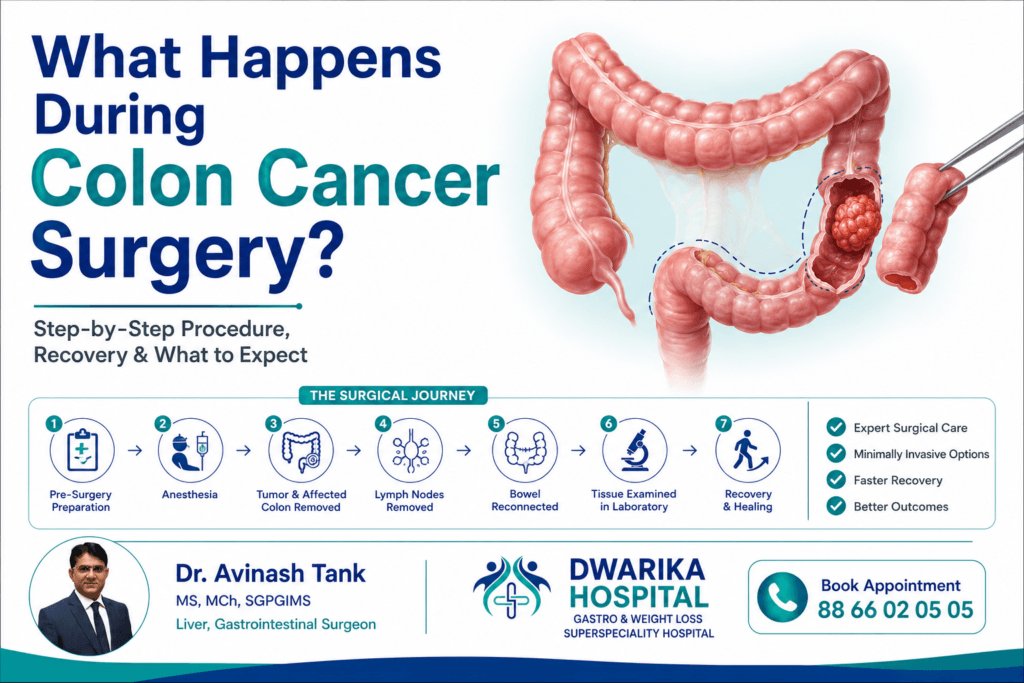
Before surgery, patients undergo preoperative evaluation, bowel preparation (when appropriate), and anesthesia. During the operation, the surgeon removes the tumour with a margin of healthy tissue and reconnects the remaining bowel whenever it is safe to do so. In some situations, a temporary or permanent stoma may be required.
Surgery may be performed using open, laparoscopic, or robotic techniques depending on the patient’s condition and tumour characteristics.
After surgery, the removed tissue is examined by a pathologist to determine the cancer stage and whether additional treatment, such as chemotherapy, is needed.
Why Patients Ask This Question
For many patients, hearing the words “You need surgery” is more frightening than hearing the diagnosis itself.
Common questions include:
- Will the whole colon be removed?
- Will I wake up with a colostomy bag?
- Is the operation painful?
- How long will the surgery take?
- What happens while I am under anesthesia?
- Will the cancer be removed completely?
- How long will recovery take?
These concerns are completely understandable. Most patients have never undergone major abdominal surgery before, and uncertainty often creates anxiety.
Understanding what actually happens during colon cancer surgery helps reduce fear, prepares patients for recovery, and allows them to participate more confidently in treatment decisions.
It is also important to remember that every patient’s operation is different. The exact procedure depends on the location of the tumour, its stage, the patient’s general health, and the surgical approach recommended by the treating team.
The Short Answer
Colon cancer surgery aims to completely remove the tumour together with nearby lymph nodes while preserving normal bowel function whenever possible.
The operation usually involves:
- General anesthesia
- Removal of the cancerous segment of the colon
- Removal of nearby lymph nodes
- Rejoining the healthy ends of the bowel (anastomosis)
- Occasionally creating a temporary or permanent stoma
- Sending the specimen for detailed pathological examination
Most patients stay in the hospital for several days after surgery and gradually return to normal activities over the following weeks.
Understanding the Background
Why Is Surgery the Main Treatment?
For most patients with Stage I, II, and Stage III colon cancer, surgery offers the best chance of cure.
Unlike chemotherapy or radiation therapy, surgery physically removes the tumour from the body. It also provides important information about the cancer by allowing pathologists to examine the tumour and lymph nodes under a microscope.
Why Are Lymph Nodes Removed?
Cancer cells can spread through the lymphatic system before they become visible on scans.
Removing nearby lymph nodes helps doctors determine:
- Whether the cancer has spread
- The exact stage of the disease
- Whether chemotherapy is recommended
This is an essential part of standard colon cancer surgery.
Does Every Patient Need the Same Operation?
No.
The type of surgery depends on:
- Tumour location
- Tumour size
- Stage of cancer
- Whether nearby organs are involved
- Previous abdominal surgery
- Overall health
- Emergency versus planned surgery
For example, a cancer in the right side of the colon requires a different operation than one in the sigmoid colon.
Detailed Answer
Step 1: Preoperative Assessment
Before surgery, your healthcare team performs a comprehensive assessment to ensure the operation can be carried out safely.
This usually includes:
- Medical history
- Physical examination
- Blood tests
- ECG
- Chest evaluation if required
- CT scan review
- Colonoscopy findings
- Assessment by the anesthesia team
Patients are also advised about medications that should be stopped before surgery, such as certain blood thinners.
Step 2: Bowel Preparation
Depending on the planned operation and your surgeon’s preference, bowel preparation may include:
- Special liquid diet
- Oral bowel-cleansing solution
- Antibiotics in selected patients
Not every patient requires full bowel preparation, as recommendations vary depending on current surgical protocols and the planned procedure.
Step 3: General Anesthesia
Colon cancer surgery is performed under general anesthesia.
This means:
- You will be completely asleep.
- You will not feel pain.
- Your breathing, heart rate, blood pressure, and oxygen levels are continuously monitored.
- An anesthesiologist remains with you throughout the operation.
Most patients remember nothing from the procedure.
Step 4: The Surgical Approach
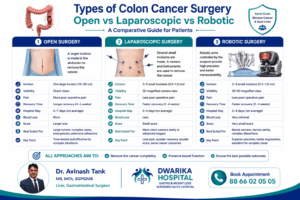
Your surgeon selects the most appropriate surgical technique.
Open Surgery
A larger incision is made in the abdomen.
It may be preferred when:
- The tumour is very large.
- There are extensive adhesions.
- Emergency surgery is required.
- The cancer involves nearby organs.
Laparoscopic Surgery
Several small incisions are made.
A camera and specialized instruments are inserted through these openings.
Potential advantages include:
- Smaller scars
- Less pain
- Reduced blood loss
- Faster recovery
- Earlier return to daily activities
Robotic Surgery
Robotic-assisted surgery is an advanced minimally invasive technique.
It offers:
- High-definition 3D visualization
- Enhanced precision
- Improved instrument movement
- Better ergonomics for complex pelvic surgery
Not every patient requires robotic surgery, but it may be beneficial in selected cases.
Step 5: Locating the Tumour
Once inside the abdomen, the surgeon identifies:
- The tumour
- Blood vessels supplying that part of the colon
- Nearby lymph nodes
- Adjacent organs
- Any unexpected spread of disease
The surgical plan is confirmed before removing the tumour.
Step 6: Removing the Cancer
The affected segment of the colon is carefully removed.
Standard cancer surgery includes removal of:
- The tumour
- A margin of healthy bowel on both sides
- The blood vessels supplying that section
- Nearby lymph nodes
This approach reduces the risk of leaving microscopic cancer behind.
Step 7: Lymph Node Removal
Lymph node removal is an essential part of curative colon cancer surgery.
The removed lymph nodes help answer important questions:
- Has cancer spread beyond the bowel?
- What is the exact stage?
- Is chemotherapy recommended?
International guidelines recommend examining an adequate number of lymph nodes for accurate staging.
Step 8: Reconnecting the Bowel (Anastomosis)
In most patients, the surgeon joins the two healthy ends of the bowel together.
This connection is called an anastomosis.
The goal is to restore normal bowel continuity so that patients can continue passing stool naturally.
Before completing the operation, the surgeon carefully checks that:
- Blood supply is good.
- The connection is tension-free.
- There is no leakage.
Step 9: Will I Need a Stoma?
One of the biggest fears patients have is waking up with a stoma.
The reassuring news is that most patients with colon cancer do not require a permanent stoma.
A stoma may be recommended if:
- The bowel cannot be safely reconnected.
- The patient presents with bowel obstruction or perforation.
- The bowel needs time to heal.
- The tumour is very low or locally advanced.
Some stomas are temporary and can be reversed after recovery, while others are permanent if reconnection is not possible.
Your surgeon will discuss this possibility before the operation whenever feasible.
Step 10: What Happens to the Removed Tissue?
The removed specimen is sent to a pathology laboratory.
The pathologist examines:
- Tumour type
- Tumour size
- Depth of invasion
- Surgical margins
- Number of lymph nodes removed
- Number of lymph nodes containing cancer
- Tumour grade
- Other important microscopic features
This pathology report determines the final stage of the cancer and helps guide decisions about additional treatment.
Step-by-Step Summary
| Step | What Happens? |
| 1 | Preoperative assessment |
| 2 | Bowel preparation (when required) |
| 3 | General anesthesia |
| 4 | Open, laparoscopic, or robotic surgery |
| 5 | Tumour identified |
| 6 | Cancer and healthy margins removed |
| 7 | Nearby lymph nodes removed |
| 8 | Healthy bowel reconnected (anastomosis) |
| 9 | Temporary or permanent stoma if required |
| 10 | Specimen sent for pathology |
What Happens Immediately After Surgery?
Once the operation is complete, you will be taken to the Post-Anesthesia Care Unit (PACU) or recovery room, where doctors and nurses closely monitor your condition as you wake up from anesthesia.
During this period, your healthcare team checks:
- Blood pressure
- Heart rate
- Oxygen levels
- Breathing
- Pain control
- Urine output
- Surgical wound
- Drain output (if a drain has been placed)
Most patients are awake within one to two hours, although some may feel sleepy, thirsty, or mildly nauseated because of the anesthesia.
What Can You Expect During Your Hospital Stay?
Recovery after colon cancer surgery follows a structured pathway designed to help patients regain normal function safely.
Day 0 (Day of Surgery)
Typical care includes:
- Recovery from anesthesia
- Intravenous fluids
- Pain control
- Deep breathing exercises
- Early leg movements to reduce the risk of blood clots
In many hospitals, patients are encouraged to sit out of bed on the same day whenever possible.
Day 1
Most patients are encouraged to:
- Sit in a chair
- Walk short distances
- Begin drinking clear fluids if appropriate
- Perform breathing exercises regularly
Early mobilization helps reduce complications such as pneumonia and blood clots.
Day 2–3
Depending on recovery:
- Diet is gradually advanced.
- Walking distance increases.
- Intravenous fluids are reduced.
- Urinary catheter may be removed.
- Pain medication is adjusted.
Doctors also assess whether the bowel has started functioning again.
Day 4–6
Many patients are ready for discharge if:
- Pain is well controlled with oral medication.
- They are eating and drinking adequately.
- Bowel function has returned.
- They are walking independently.
- There are no signs of complications.
Hospital stay varies depending on the type of surgery, individual recovery, and whether the operation was performed using an open or minimally invasive approach.
When Can I Eat Again?
Many patients worry they will not be able to eat for several days.
Modern surgical practice encourages early feeding whenever it is safe.
Typical progression includes:
- Clear liquids
- Full liquids
- Soft diet
- Regular diet as tolerated
The pace depends on:
- Return of bowel function
- Absence of nausea or vomiting
- Overall recovery
Your surgeon will advise when it is appropriate to advance your diet.
Pain Management
Pain control is an important part of recovery.
Options may include:
- Intravenous pain medication
- Epidural analgesia (selected patients)
- Oral pain medicines
- Local anesthetic techniques
- Multimodal pain management
The goal is to keep pain controlled well enough to allow:
- Walking
- Deep breathing
- Coughing
- Sleeping comfortably
- Early recovery
Patients should inform the healthcare team if pain is not adequately controlled.
Possible Risks and Complications
Every operation carries some risks, although most patients recover without major problems.
Possible complications include:
- Bleeding
- Infection
- Anastomotic leak (leak from the bowel connection)
- Injury to nearby organs
- Blood clots
- Pneumonia
- Ileus (temporary slowing of bowel function)
- Urinary infection
- Wound complications
The likelihood of complications depends on factors such as age, overall health, nutritional status, smoking, diabetes, emergency surgery, and tumour stage.
Your surgical team takes numerous precautions to minimize these risks.
What Is ERAS (Enhanced Recovery After Surgery)?
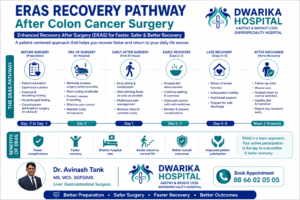
Many hospitals now follow Enhanced Recovery After Surgery (ERAS) programmes.
ERAS is an evidence-based approach designed to help patients recover more quickly after major surgery.
It includes:
- Better patient education
- Optimized nutrition
- Minimal fasting
- Early mobilization
- Early feeding
- Effective pain control
- Reduced use of tubes and drains whenever appropriate
Studies have shown that ERAS programmes can shorten hospital stay and improve patient recovery without compromising safety.
When Will I Receive My Pathology Report?
Although the tumour has been removed during surgery, important information is still awaited.
The pathology report usually becomes available within 5–10 days, although timing varies by laboratory.
The report includes:
- Exact tumour type
- Tumour size
- Depth of invasion
- Number of lymph nodes examined
- Number of positive lymph nodes
- Surgical margins
- Tumour grade
- Presence of lymphovascular or perineural invasion
This information determines the final stage of the cancer and whether chemotherapy is recommended.
What Current Evidence Shows
International guidelines from the NCCN, ASCO, ESMO, and the World Health Organization (WHO) recommend surgery as the primary treatment for most patients with localized colon cancer.
Current evidence demonstrates that:
- Complete removal of the tumour with adequate surgical margins offers the best chance of cure.
- Removal and examination of an adequate number of lymph nodes improves staging accuracy.
- Laparoscopic and robotic surgery provide cancer outcomes comparable to open surgery in appropriately selected patients while offering benefits such as smaller incisions and faster recovery.
- ERAS programmes improve recovery, reduce complications, and shorten hospital stay.
- Treatment decisions made by a multidisciplinary team—including surgeons, gastroenterologists, oncologists, radiologists, and pathologists—lead to better patient outcomes.
The strongest evidence continues to show that early diagnosis followed by timely surgery provides the greatest opportunity for long-term survival and cure.
Common Myths and Facts
Myth 1: The surgeon removes the entire colon.
Fact: In most cases, only the section of the colon containing the tumour, along with nearby lymph nodes, is removed.
Myth 2: Every patient needs a permanent colostomy.
Fact: Most patients with colon cancer do not require a permanent stoma. When a stoma is necessary, it is often temporary.
Myth 3: Open surgery is always better than laparoscopic or robotic surgery.
Fact: Minimally invasive surgery offers similar cancer outcomes in suitable patients while often providing faster recovery and less postoperative discomfort.
Myth 4: Once the tumour is removed, treatment is finished.
Fact: The pathology report determines whether additional treatment, such as chemotherapy, is recommended.
Myth 5: You must remain in bed for several days after surgery.
Fact: Early walking is encouraged because it reduces the risk of complications and speeds recovery.
Myth 6: Colon cancer surgery is extremely painful.
Fact: Modern anesthesia techniques, multimodal pain management, and ERAS protocols help keep postoperative pain well controlled for most patients.
Dr. Avinash Tank’s Perspective
Many patients imagine colon cancer surgery as a frightening and unpredictable experience.
In reality, it is a carefully planned procedure performed by a multidisciplinary team focused on both cancer control and patient recovery.
The operation is not simply about removing the tumour. It also involves preserving healthy bowel whenever possible, ensuring adequate lymph node removal for accurate staging, and restoring bowel continuity safely.
Just as important is the care provided after surgery—effective pain management, early mobilization, nutritional support, and careful monitoring all contribute to a successful recovery.
Every patient’s situation is unique. Before surgery, I encourage patients and their families to ask questions, understand the planned procedure, and discuss the possibility of a temporary or permanent stoma if relevant. Being informed helps reduce anxiety and prepares patients for the recovery journey.
Key Takeaways
- ✓ Colon cancer surgery removes the tumour along with nearby lymph nodes.
- ✓ Most patients undergo surgery under general anesthesia.
- ✓ The bowel is usually reconnected after the diseased segment is removed.
- ✓ A permanent stoma is not required for most patients.
- ✓ Pathology determines the final cancer stage and need for additional treatment.
- ✓ Early walking and nutrition help speed recovery.
- ✓ ERAS programmes improve recovery and reduce complications.
- ✓ Laparoscopic and robotic surgery are effective options for selected patients.
- ✓ Surgery remains the cornerstone of treatment for most localized colon cancers.
Related Resources
Disease Hub
- Colon Cancer Knowledge Hub
Service Pages
- Colon Cancer Surgery
- Laparoscopic Colon Surgery
- Robotic Colon Surgery
- Colonoscopy
Related Patient Education Articles
- Can Colon Cancer Be Cured by Surgery?
- How Is Colon Cancer Diagnosed?
- What Are the First Signs and Symptoms of Colon Cancer?
- Can Colon Cancer Be Detected in a Blood Test?
- Can Colon Cancer Come Back After Surgery?
Frequently Asked Questions
1. How long does colon cancer surgery usually take?
Most colon cancer operations take 2–4 hours, depending on the tumour’s location, complexity of the procedure, previous abdominal surgery, and whether additional organs are involved.
2. Will I wake up with a colostomy bag?
Most patients do not require a permanent colostomy. If a stoma is needed, it may be temporary to allow the bowel to heal before it is reversed.
3. Is colon cancer surgery painful?
Some discomfort is expected, but modern pain management techniques help keep pain under good control and allow patients to walk and recover more comfortably.
4. When can I start eating after surgery?
Many patients begin drinking fluids within the first day after surgery and gradually progress to a normal diet as bowel function returns, following their surgeon’s guidance.
5. How long will I stay in the hospital?
Hospital stay varies depending on the type of surgery and recovery. Patients who undergo minimally invasive surgery and recover without complications may be discharged sooner than those requiring open surgery or emergency procedures.
6. When can I return to normal activities?
Light daily activities are encouraged soon after discharge, but heavy lifting and strenuous exercise should be avoided until your surgeon confirms it is safe. Recovery time varies from person to person.
7. Will I need chemotherapy after surgery?
Not everyone does. The decision depends on the final pathology report, including the tumour stage, lymph node involvement, and other high-risk features.
8. How often will I need follow-up after surgery?
Regular follow-up usually includes physical examinations, blood tests (including CEA when appropriate), imaging, and scheduled colonoscopies to monitor recovery and detect any recurrence or new polyps.
References
- National Comprehensive Cancer Network (NCCN). Clinical Practice Guidelines in Oncology: Colon Cancer.
- American Society of Clinical Oncology (ASCO). Colorectal Cancer Guidelines.
- European Society for Medical Oncology (ESMO). Clinical Practice Guidelines for Colon Cancer.
- World Health Organization (WHO). Colorectal Cancer Fact Sheet.
- National Cancer Institute (NCI). Colon Cancer Treatment (PDQ®).
- Gustafsson UO, et al. Guidelines for Perioperative Care in Elective Colorectal Surgery: Enhanced Recovery After Surgery (ERAS) Society Recommendations.
- Benson AB, et al. NCCN Guidelines Insights: Colon Cancer.
- Fleshman J, et al. Laparoscopic Colectomy for Cancer: Long-Term Outcomes
Learn More About Colon Cancer
Understanding what happens during colon cancer surgery can help you prepare for treatment with greater confidence.
Visit our Colon Cancer Knowledge Hub to learn about symptoms, diagnosis, staging, treatment options, recovery, nutrition, and long-term follow-up through evidence-based patient education.
Request a Specialist Evaluation
If you have been advised to undergo colon cancer surgery or would like a second opinion about your treatment options, consult a gastrointestinal cancer surgeon.
A detailed evaluation—including review of imaging, pathology, and overall health—can help determine the most appropriate surgical approach and create a personalized treatment plan aimed at achieving the best possible outcome.

Super-specialist GI, bariatric & cancer surgeon. SGPGIMS (India's premier GI centre) + advanced training in Japan & South Korea. Read full profile →
Last reviewed: July 2026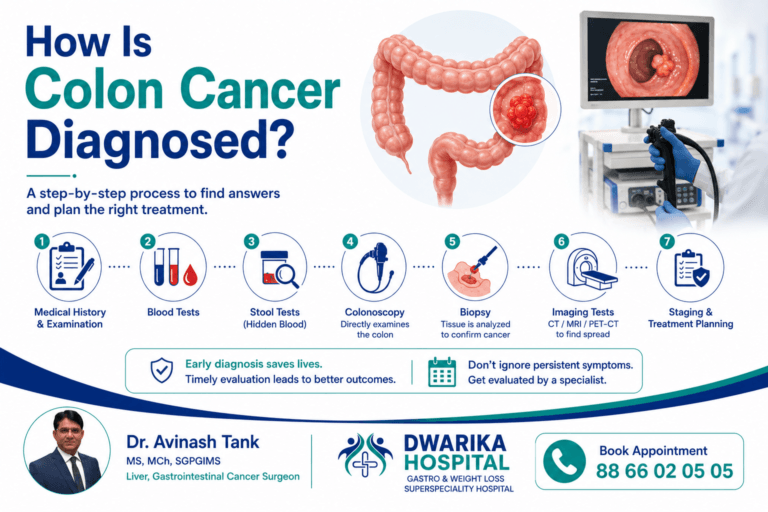



Comments
Be the first to share your thoughts on this article.