

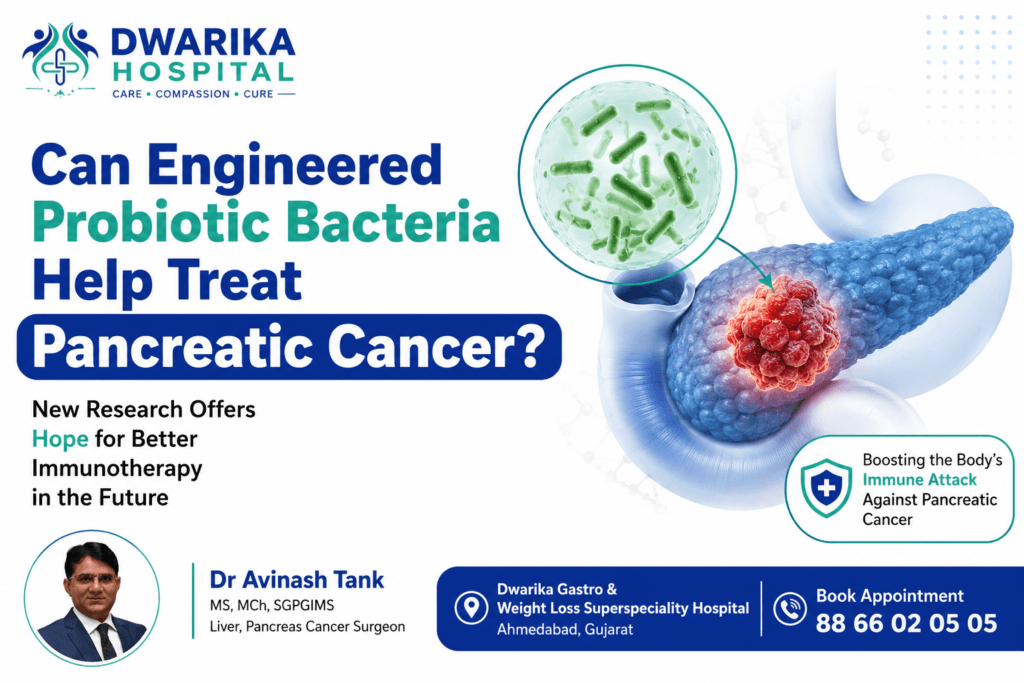
Can Engineered Probiotic Bacteria Help Treat Pancreatic Cancer?
New Research Explained in Simple Questions and Answers
Researchers have developed a promising new approach to treating pancreatic cancer using genetically engineered probiotic bacteria.
Instead of attacking the cancer directly, these specially modified bacteria help the body’s own immune system recognize and fight cancer cells more effectively.
Although this treatment is still experimental and is not yet available for patients, it represents an exciting step forward in pancreatic cancer research.
What is the latest news about pancreatic cancer treatment?
Scientists have developed genetically engineered probiotic bacteria that can travel to pancreatic tumors and release immune-boosting proteins directly inside the cancer. This helps activate the body’s immune system to attack cancer cells more effectively.
The research has shown encouraging results in laboratory and animal studies, raising hope for future treatments for one of the most difficult cancers to treat.
What was this research study about?
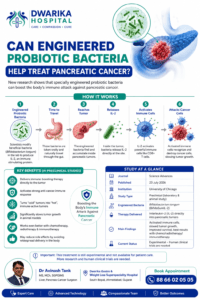
This research was conducted by scientists at the University of Chicago and published in the prestigious peer-reviewed journal Science Advances on 23 July 2026.
The researchers developed an engineered probiotic called BifidoSumIL-2, which is based on the naturally occurring probiotic Bifidobacterium longum.
The goal was to use these bacteria as tiny “living drug delivery systems” that could safely reach pancreatic tumors and continuously release immune-stimulating proteins directly where they are needed.
Unlike conventional medicines that circulate throughout the body, these engineered bacteria concentrate inside the tumor, potentially making treatment more effective while reducing side effects.
What are probiotic bacteria?
Probiotics are beneficial bacteria that naturally live in our intestines and help maintain digestive and immune health.
However, the bacteria used in this research are not ordinary probiotics. Scientists genetically modified them in the laboratory so they can specifically target pancreatic tumors and deliver cancer-fighting molecules.
Why is pancreatic cancer so difficult to treat?
Pancreatic cancer is one of the deadliest cancers because:
- It is often diagnosed late.
- It spreads quickly.
- Surgery is possible in only a minority of patients.
- It creates an environment that hides the tumor from the immune system.
Doctors often describe pancreatic cancer as an “immune-cold” tumor, meaning the body’s immune cells have difficulty recognizing and attacking it.
This is one reason why immunotherapy has not been as successful in pancreatic cancer as it has been in melanoma or lung cancer.
How do engineered probiotic bacteria work against pancreatic cancer?
The researchers genetically modified Bifidobacterium longum to produce a protein called Interleukin-2 (IL-2).
IL-2 is a powerful immune-stimulating protein that activates cancer-fighting T cells.
After entering the body, the engineered bacteria:
- Naturally migrate toward pancreatic tumors.
- Multiply within the low-oxygen environment of the tumor.
- Release IL-2 directly inside the tumor.
- Activate immune cells.
- Help immune cells recognize and destroy cancer cells.
This targeted delivery may reduce the serious side effects seen when IL-2 is given throughout the body.
Why is IL-2 important in cancer treatment?
IL-2 is a naturally occurring protein made by the immune system.
It helps:
- Activate killer T cells
- Increase immune response
- Destroy abnormal cells
- Improve cancer-fighting ability
Although IL-2 has been used to treat some cancers, giving it through the bloodstream can cause severe side effects.
The engineered bacteria act like tiny biological factories that release IL-2 only inside the tumor, making treatment potentially safer.
Which immune cells become stronger after this treatment?
The study showed increased activity of:
- CD8+ killer T cells
- Tumor-fighting lymphocytes
- Other immune cells involved in destroying pancreatic cancer
Researchers also found that the tumor environment changed from an immune-resistant (“cold”) state to a more immune-active (“hot”) state, allowing immune cells to attack the cancer more effectively.
What did the study find?
The preclinical study showed several encouraging results.
The engineered bacteria:
- Successfully reached pancreatic tumors.
- Survived inside the tumors.
- Released IL-2 continuously.
- Activated cancer-fighting immune cells.
- Significantly slowed tumor growth.
- Improved survival in animal models.
Researchers also found that the treatment worked even better when combined with standard cancer therapies.
Can this treatment be combined with chemotherapy or immunotherapy?
Yes.
One of the most exciting findings was that the engineered bacteria enhanced the effectiveness of other treatments, including:
- Chemotherapy
- Radiotherapy
- Anti-PD-L1 immunotherapy
Combination treatment produced better tumor control than any single treatment alone.
If future human studies confirm these findings, engineered probiotics may become part of combination treatment strategies for pancreatic cancer.
Is this treatment available for patients today?
No.
This treatment is still experimental.
So far, it has only been tested in laboratory experiments and animal models.
Before it can become available for patients, researchers must complete:
- Human clinical trials
- Safety testing
- Dose optimization
- Regulatory approval
Until then, surgery, chemotherapy, radiotherapy, targeted therapy, and currently approved immunotherapies remain the standard treatments for pancreatic cancer.
Should patients take probiotic supplements for pancreatic cancer?
No.
There is no scientific evidence that probiotic capsules, yogurt, or commercially available probiotics can treat pancreatic cancer.
The bacteria used in this research are genetically engineered in highly specialized laboratories and are completely different from probiotics sold as dietary supplements.
Patients should never replace standard cancer treatment with over-the-counter probiotics.
Could engineered bacteria become the future of cancer treatment?
Possibly.
Scientists believe engineered bacteria could become an entirely new way of treating cancer by:
- Delivering medicines directly into tumors
- Activating the immune system
- Making immunotherapy more effective
- Reducing treatment side effects
- Personalizing cancer treatment
Although much work remains, this field is rapidly growing and may transform cancer care over the next decade.
What does this research mean for patients?
This research offers hope—but not an immediate cure.
The findings suggest that engineered probiotic bacteria may one day help doctors treat pancreatic cancer more effectively by working alongside surgery, chemotherapy, radiotherapy, and immunotherapy.
However, patients should understand that this treatment is still in the research stage and is not yet available in hospitals.
Frequently Asked Questions (FAQs)
Can probiotics cure pancreatic cancer?
No. There is currently no evidence that regular probiotic supplements can cure pancreatic cancer.
Are these the same probiotics found in yogurt?
No. These bacteria have been genetically engineered specifically for cancer treatment and are very different from ordinary probiotics.
Has this treatment been approved?
No. It remains an experimental therapy and has not yet been approved for routine patient care.
Will this replace pancreatic cancer surgery?
No.
For patients with early-stage pancreatic cancer, surgery remains the best chance for long-term survival and potential cure.
If future studies are successful, engineered bacteria may be used alongside surgery and other cancer treatments—not instead of them.
What is the biggest advantage of this research?
Instead of giving immune-stimulating medicines throughout the body, scientists can deliver them directly inside pancreatic tumors using engineered bacteria. This targeted approach may improve treatment effectiveness while reducing side effects.
Study at a Glance
| Feature | Details |
| Journal | Science Advances |
| Published | 23 July 2026 |
| Research Institution | University of Chicago |
| Study Type | Preclinical (Laboratory and Animal Study) |
| Engineered Bacteria | Bifidobacterium longum (BifidoSumIL-2) |
| Therapy Delivered | Interleukin-2 (IL-2) directly into pancreatic tumors |
| Main Findings | Activated immune cells, converted tumors from “cold” to “hot,” slowed tumor growth, and improved response to chemotherapy, radiotherapy, and immunotherapy |
| Current Status | Experimental; human clinical trials are still needed |
What Does This Mean for Indian Patients with Pancreatic Cancer?
For patients in India, this research offers hope for the future, but it is important to understand its current limitations.
At present, engineered probiotic bacteria are not available as a treatment in India or anywhere else in the world. The therapy has shown promising results only in laboratory and animal studies.
Human clinical trials are the next essential step before doctors can determine whether it is safe and effective for patients.
What should Indian patients do now?
If you have been diagnosed with pancreatic cancer, the best treatment depends on the stage of the disease, the location of the tumor, and your overall health. Current evidence-based treatment options include:
- Surgery for patients with resectable (operable) pancreatic cancer, which offers the best chance of long-term survival and potential cure.
- Chemotherapy before or after surgery to improve outcomes.
- Radiotherapy in selected patients.
- Targeted therapy or immunotherapy for carefully selected patients based on the tumor’s genetic profile.
- Palliative care to relieve symptoms and improve quality of life in advanced disease.
Treatment should always be planned by a multidisciplinary team (MDT) that includes pancreatic surgeons, medical oncologists, radiation oncologists, gastroenterologists, radiologists, and pathologists.
Key Takeaway
This innovative study demonstrates that genetically engineered probiotic bacteria can act as living medicine factories, delivering immune-boosting proteins directly into pancreatic tumors.
In preclinical studies, this approach activated powerful cancer-fighting immune cells, slowed tumor growth, and enhanced the effectiveness of chemotherapy, radiotherapy, and immunotherapy.
While this treatment is not yet available for patients, it represents one of the most promising advances in pancreatic cancer immunotherapy.
Future human clinical trials will determine whether this exciting laboratory discovery can become a safe and effective treatment option for people with pancreatic cancer.
Expert Comment – Dr. Avinash Tank
Pancreatic cancer remains one of the most challenging cancers to treat.
Surgical removal of the tumor continues to offer the best chance of cure when the disease is diagnosed early.
Research such as this opens the possibility of making advanced pancreatic cancers more responsive to immunotherapy by harnessing the body’s own immune system.
Although this approach is still experimental, it highlights the rapid progress being made toward more precise and personalized cancer treatments.
Pancreas Related Articles for Further Reading

Super-specialist GI, bariatric & cancer surgeon. SGPGIMS (India's premier GI centre) + advanced training in Japan & South Korea. Read full profile →
Last reviewed: July 2026





Comments
Be the first to share your thoughts on this article.